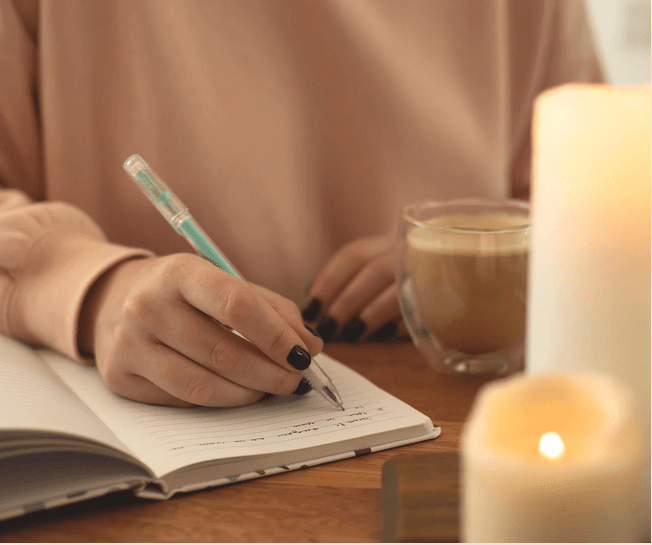
When I first started journaling, I thought it had to look a certain way. Clean. Organized. Poetic, even. I’d seen those perfect spreads on Pinterest and Instagram—minimalist black ink on white pages, or aesthetic bullet journal layouts that looked like they belonged in an art gallery. And while they were beautiful, they also made me feel like I had to live up to a standard that didn’t reflect me at all.
So I’d write carefully, second-guessing every word. I’d rip pages out if my handwriting wasn’t neat. If I made a spelling mistake? That was it—start over. Instead of being a creative release, journaling became another thing I tried to control. It wasn’t until I gave up on trying to make my journal perfect that it actually became something I looked forward to again.
That shift started small. I remember one day I randomly drew a crooked little sun in the corner of the page. It wasn’t planned—it just happened while I was thinking. And I liked how it felt. It made the page feel like mine. So the next day, I added some color. Then came stickers. Then washi tape. Suddenly, my journal pages weren’t just filled with words—they were alive with layers and texture and mood.
Creative journaling has since become my favorite form of self-expression. It’s where I unload my thoughts, yes—but it’s also where I let myself play. I’ll add watercolor swirls around a quote I love. I’ll glue in candy wrappers from a fun night out, or use a stencil to make a border. Some pages are chaotic collages of emotions and scribbles. Others are quiet and simple, with just a doodle in the corner and one sentence that says all I need it to.
Washi tape deserves its own love letter here. I seriously didn’t know how fun it could be until I bought my first roll “just to try.” Now I have a little box of tapes—florals, pastels, stars, polka dots—and I reach for them all the time. I use them to section off parts of a page, frame quotes, attach photos, or just add a pop of color when the mood strikes. There’s something so satisfying about tearing a strip and placing it just where you want it—like a tiny act of intentional beauty.
One of the best parts of creative journaling is how it helps me process emotions. When I’m overwhelmed, I’ll grab a page and just start with color. No words yet—just strokes of marker, paint, or crayon. The act of creating a visual background often helps me get to the core of what I’m feeling. Sometimes I’ll add a poem, or a memory that feels tied to the emotion. Other times, the page stays abstract. Either way, I always feel lighter after.
And then there are the pages that surprise me. The ones where I started writing about one thing, and ended up somewhere completely different. Where I glued in a receipt or a pressed flower, and that tiny object sparked a whole train of thought. That’s the magic of creative journaling—it gives you space to explore, not just report. It’s less “here’s what happened” and more “here’s what it meant.”
What I’ve learned through all of this is that creativity doesn’t thrive in restriction. It blossoms in freedom, in play, in letting go. And sometimes, the most powerful thing we can do for ourselves is allow the mess. Allow the crooked lines. The typos. The colors that clash. The pages that look silly, or raw, or half-finished. They’re all part of the story.
So if you’ve ever felt like you’re not “good” at journaling, or that your journal isn’t pretty enough—stop right there. Your journal doesn’t have to be anything but yours. Let it be messy. Let it be weird. Let it be wild. Because in that freedom, you might just find the part of yourself that’s been waiting to be heard.
Grab your pens. Rip up a magazine. Smudge a page with paint. Let the journal be a space where you’re not trying to impress anyone—not even yourself.
Just create.




 Cups & Curiosity
Leave a comment