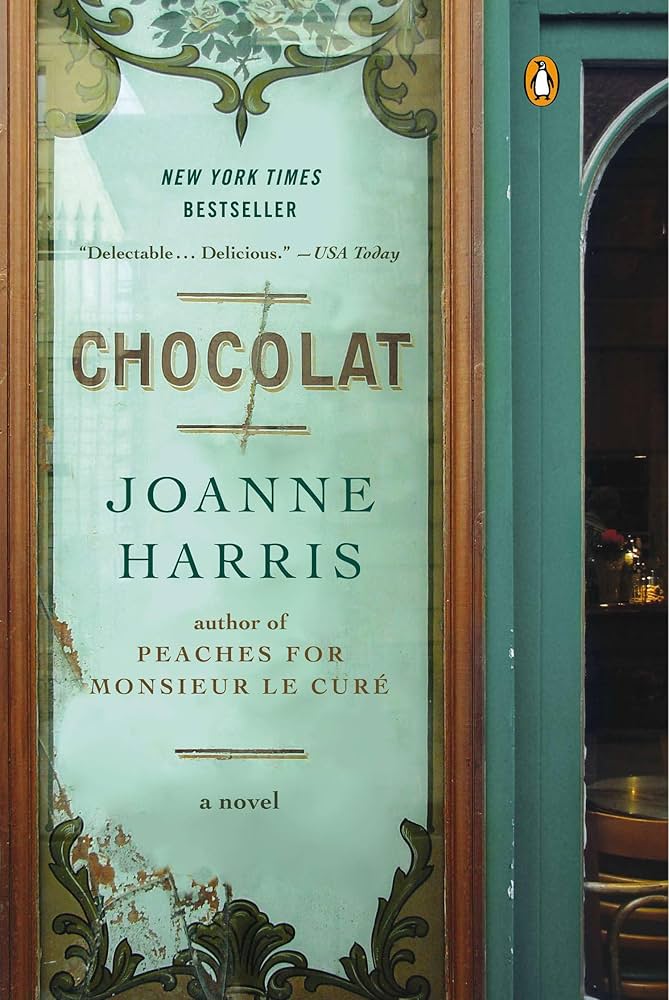
There are some books that feel like they were meant to be savored slowly, like a piece of good dark chocolate melting on your tongue. Joanne Harris’s Chocolat is one of those books. It’s rich, indulgent, a little bittersweet, and it leaves you thinking about more than just the story on the page. It’s about temptation, belonging, joy, and what it means to break free from the rules that others set for us.
The novel takes us to Lansquenet-sous-Tannes, a quiet little French village that seems stuck in time. Into this rigid, almost suffocating place comes Vianne Rocher, drifting in with her young daughter Anouk and opening a chocolate shop during Lent—scandalous, of course. Vianne’s shop becomes more than just a place to buy sweets. It turns into a sanctuary where villagers come not only for handmade truffles and hot cocoa but also for warmth, acceptance, and a kind of freedom they didn’t even realize they were missing.
What makes Chocolat so magical is the way Harris writes with such sensory detail. You can practically taste the sugared violets, feel the snap of a perfectly tempered praline, and smell the cinnamon and chili mingling in a cup of hot chocolate. But beyond the delicious imagery, the book has heart. It’s about people finding themselves again after being stifled—whether by tradition, fear, or the judgment of others. Through Vianne, Harris reminds us that joy and kindness can be revolutionary acts.
The real tension comes from the clash between Vianne and Father Reynaud, the local priest. To him, chocolate symbolizes sin, indulgence, and weakness. He is determined to maintain control of the village through discipline and fear, while Vianne offers something more liberating: the permission to simply enjoy life. Their battle isn’t just about chocolate; it’s about whether people should live under rigid rules or allow themselves moments of sweetness, love, and connection.
The characters surrounding Vianne make the story even richer. Josephine, who learns to reclaim her life from an abusive marriage. Armande, the elderly woman who refuses to be tucked quietly into old age. Roux, the traveler who stirs up both romance and rebellion. Each of them is transformed, not just by chocolate, but by Vianne’s insistence that life doesn’t have to be lived in fear. These moments of transformation feel quiet yet powerful—like little revolutions taking place over a steaming mug of cocoa.
One of my favorite aspects of the book is the touch of magical realism. Vianne seems to have an intuitive gift, knowing exactly what chocolate someone will crave. It gives the novel an almost fairy-tale quality, where magic doesn’t come from spells or wands but from something softer—intuition, kindness, and the courage to listen. It makes the whole story feel enchanting, like a whispered secret you carry with you after closing the book.
Comparing to the Movie
If you’ve seen the 2000 film adaptation with Juliette Binoche and Johnny Depp, you’ll notice some differences. The movie captures the charm and coziness of the village beautifully—the cobblestone streets, the river gypsy boats, the swirl of melted chocolate poured onto marble. Binoche embodies Vianne’s warmth, while Judi Dench as Armande is unforgettable. However, the film softens some of the darker edges of the book. Father Reynaud, for instance, is portrayed more comically in the movie, while in the novel his character is steeped in guilt, repression, and self-loathing, which makes the conflict more layered. The movie leans into romance and community spirit, making it feel like a heartwarming fable, while the book digs deeper into questions of morality, tradition, and the weight of personal freedom. Both versions are delightful, but the novel lingers in a way the movie doesn’t—it stays with you, challenging you to think about where joy and kindness fit into your own life.
Final Thoughts
Reading Chocolat feels like curling up with something warm and comforting, but also thought-provoking. It’s cozy, yes, but it also nudges you to reflect on how easy it is to let rules or expectations control your choices. Sometimes, as Harris suggests, choosing a little sweetness is an act of courage.
For me, Chocolat was both an escape and a gentle reminder to embrace small pleasures without guilt. Whether it’s a square of dark chocolate after dinner, a lazy Sunday morning spent journaling with a hot coffee, or simply choosing joy in a moment of stress—these little indulgences can be powerful. They can connect us to others, to ourselves, and to a life lived more fully.
So if you’re looking for a book that feels like comfort food but also offers layers of meaning, Chocolat is the perfect pick. Just don’t be surprised if you find yourself craving something sweet the moment you turn the last page.




 Cups & Curiosity
Leave a comment